The Manila Light Rail Transit System, or LRT, is a major public transport system in Metro Manila, Philippines. It has two lines, 38 stations, and a network length of 43.5 kilometers (27.0 miles), with most of the route elevated. Line 1 opened in 1984 and runs mainly north to south, while Line 2 was completed in 2004 and runs east to west. The system is operated by the Light Rail Transit Authority and Light Rail Manila Corporation, and it forms an important part of transportation in Metro Manila alongside MRT and PNR services.
| Key | Information |
|---|---|
| System | Manila Light Rail Transit System |
| Common name | LRT |
| Lines | 2 |
| Stations | 38 |
| Network length | 43.5 km (27.0 miles) |
| Main operators | LRTA and LRMC |
| Line 1 opening | 1984 |
| Line 2 completion | 2004 |
| Average daily ridership in 2024 | 470,000 passengers |
| Ticket system | Beep contactless card and single journey ticket |
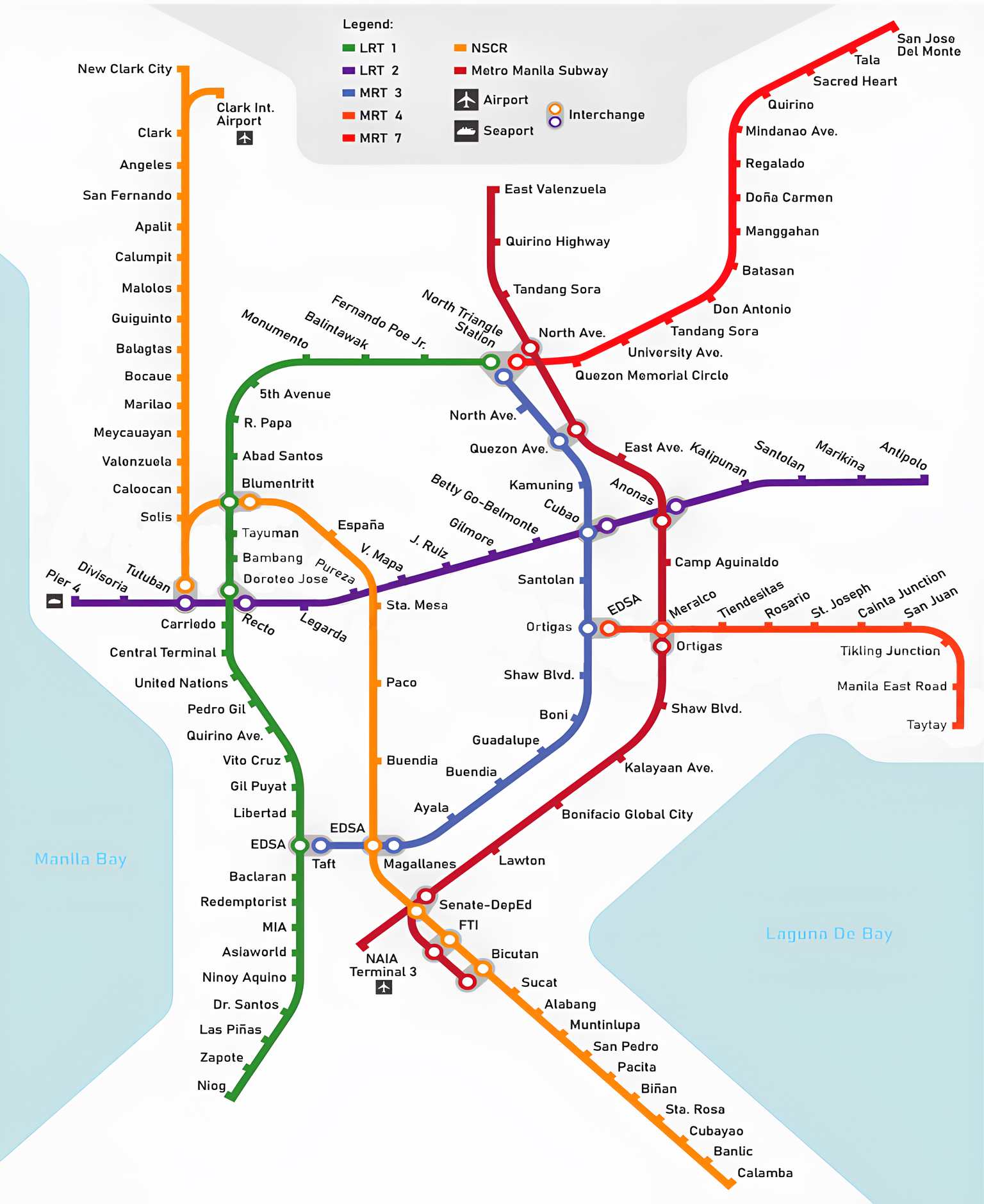
Manila Light Rail Transit System Map
Map of Manila Light Rail Transit System showing different lines and stations. Click on the map to enlarge it or download the Manila Light Rail Transit System map in PDF format.
Line and Stations
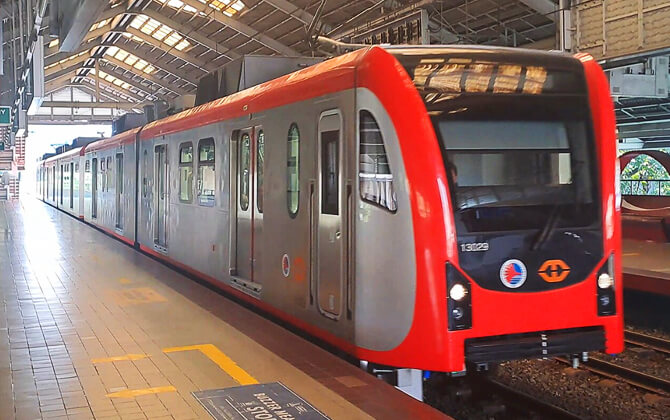
LRT Line 1 is one of the two lines in the Manila Light Rail Transit System. It runs on a fully elevated route of about 26 kilometers (16.2 miles) and currently has 25 stations. The route follows a general north-south alignment from Dr. Santos to Monumento, then continues east-west from Monumento to Fernando Poe Jr.
Originally known as Metrorail and later the Yellow Line, it was reclassified as the Green Line in 2012. Today, it remains closely tied to Metro Manila city transport, with many riders continuing their trip by bus or jeepney.
Some stations are especially important for transfers and local transport connections. Doroteo Jose links indirectly with Recto on Line 2 through a covered walkway. Blumentritt sits directly above the PNR Metro Commuter Line station, while EDSA connects with Taft Avenue through another covered walkway. No interchange is within the paid areas, though a future link with the Metro Manila Subway at PITX is planned.
The line also serves major activity hubs across Quezon City, Caloocan, Manila, Pasay, and Parañaque. Several more stations are expected as the expansion continues into Las Piñas and Bacoor.
| Station | Details |
|---|---|
| Doroteo Jose | Indirect connection to Recto on Line 2 via covered walkway |
| Blumentritt | Directly above the PNR Metro Commuter Line station |
| EDSA | Connected with Taft Avenue by covered walkway |
| Central Terminal | Major transport and activity hub |
| Gil Puyat | Major transport and activity hub |
| Baclaran | Major transport and activity hub |
| Redemptorist–Aseana | Opened as part of Cavite Extension Phase 1 in 2024 |
| MIA Road | Opened as part of Cavite Extension Phase 1 in 2024 |
| PITX | Major transport hub and planned future subway connection |
| Dr. Santos | Southern terminus after the 2024 extension phase |
| North Triangle | Planned future station |
Several stations opened in stages as the route expanded.
| Station | Details |
|---|---|
| Baclaran – Central Terminal | Partial operations began on December 1, 1984 |
| Carriedo | Opened on April 14, 1985 |
| Doroteo Jose – Monumento | Initial completion on May 12, 1985 |
| Balintawak | North Extension opened on March 22, 2010 |
| Fernando Poe Jr. | North Extension opened on October 22, 2010 |
| Redemptorist–Aseana – Dr. Santos | Cavite Extension Phase 1 opened on November 16, 2024 |
The station layout and route plan reflect the line’s role as one of the busiest transport corridors in Metro Manila.
Schedules, Timetables, and Calendar
The Manila Light Rail Transit System runs daily, but operating hours, opening times, and closing time vary by line and by day. If you are checking timings today or planning a last train connection, it is smart to look for the latest announcements before you travel.
For LRT Line 1, regular service runs from 4:30 a.m. to 10:45 p.m. on weekdays and from 5:00 a.m. to 9:45 p.m. on weekends and holidays. For LRT Line 2, all stations open daily at 4:50 a.m., while the last train and closing time depend on station and direction.
Special schedule updates are announced through station public address systems, advertisements, press releases, and operator channels. During Holy Week, the system closes for annual maintenance and reopens after Easter Sunday. Around Christmas, opening hours and working hours are often extended before Christmas Day and shortened on Christmas Eve and New Year’s Eve.
Monday through Friday
On weekdays, the system runs from 4:30 a.m. to 10:15 p.m. PST (UTC+8). This timetable applies to both lines unless a special operating schedule is announced.
Holiday periods and seasonal changes can affect the regular route timetable. Holy Week brings a full closure for maintenance, while Christmas schedules may shift depending on the date.
| Service detail | Timings |
|---|---|
| Weekday starting time | 4:30 a.m. |
| Weekday closing time | 10:15 p.m. |
| Line 1 regular weekday service | 4:30 a.m. to 10:45 p.m. |
| Line 2 station opening hours | All stations open daily at 4:50 a.m. |
For schedule today updates, passengers should check operator notices before heading out.
Saturdays and Sundays
Weekend service uses different opening times and train frequency, so checking the timetable in advance helps. On Line 1, trains run from 5:00 a.m. to 9:45 p.m. on weekends and holidays. On Line 2, stations still open at 4:50 a.m., with closing times listed by station and direction.
Special notices may still affect running time, route timetable, or service patterns.
| Service detail | Timings |
|---|---|
| Line 1 weekend opening hours | 5:00 a.m. |
| Line 1 weekend closing time | 9:45 p.m. |
| Line 2 station opening hours | 4:50 a.m. daily |
| Holy Week service | Closed for annual maintenance |
During the Christmas season, service may run longer on some days and close earlier on others.
Holidays
Holiday schedule changes are announced in advance, especially during busy travel periods. Opening hours are usually maintained, but closing time and last train timings may change.
For Line 2, stations open daily at 4:50 a.m., while the last train depends on direction. During December, selected days may get extended working hours, while Christmas Eve and New Year’s Eve often have shorter service.
| Service detail | Timings |
|---|---|
| Line 2 opening times | 4:50 a.m. daily |
| Holiday closing time | Varies by announcement |
| Christmas season timings | May be extended before Christmas Day and shortened on Christmas Eve and New Year’s Eve |
| Holy Week | System closed for annual maintenance |
If you need exact timings today, always check the latest service announcement before you go.
Ticket Pricing and Types
The Manila Light Rail Transit System uses a fare structure based on the line and the ticket type. Both Line 1 and Line 2 offer single journey tickets and the stored-value Beep card. In general, the Beep card is the more practical option for regular travel and usually comes with a lower fare.
| Line | Line 1 | Line 2 |
|---|---|---|
| Boarding fare | ₱16.25 (about $0.28) | ₱13.29 (about $0.23) |
| Distance fare | ₱1.47/km (about $0.03/km) | ₱1.21/km (about $0.02/km) |
| Minimum ticket price | ₱20.00 (about $0.35) | ₱15.00 (about $0.26) |
| Maximum ticket price | ₱55.00 (about $0.96) | ₱35.00 (about $0.61) |
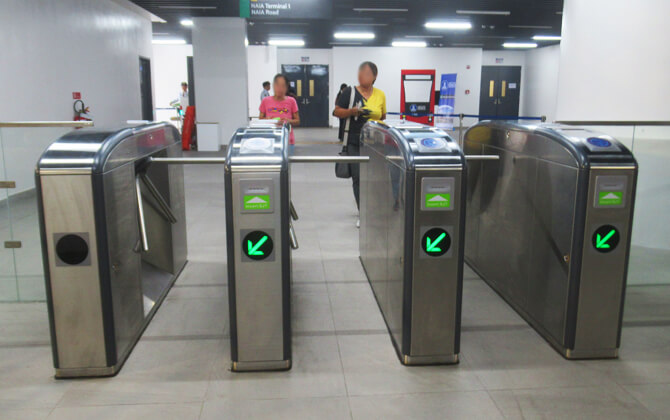
A single journey ticket is valid for one trip on the day of purchase. After use, you need to buy a new one. The Beep card is a contactless card that works on both LRT lines and on MRT lines as well, making it useful if you use public transport often.
Tickets can be bought at staffed booths or ticket machines in stations. When transferring between lines, a new fare is charged.
Discounts apply to eligible passengers. Senior citizens and persons with disabilities receive a 20% discount. Students are also entitled to a 50% fare discount starting June 20, 2025, while senior citizens and PWDs followed on July 16.
If you want the simplest option, buy a single journey ticket. If you travel often, the Beep card works better as a reusable pass for day-to-day transport.
Connections
The Manila Light Rail Transit System connects with other rail services and road-based transport across Metro Manila. Most transfers require leaving one station and using a covered walkway or nearby street to reach the next line.
Key interchange points include Recto and Doroteo Jose within the LRTA system, Araneta Center–Cubao for MRT access, EDSA for another LRT-MRT interchange, Blumentritt for the PNR Metro Commuter Line, and Pureza within walking distance of PNR. No rapid transit transfers are located within paid areas.
Several stations also link well with bus terminals and busy city transport corridors. Doroteo Jose provides access to Avenida Bus Terminal, Central Terminal to Plaza Lawton, Gil Puyat to Buendia Bus Terminal, EDSA to Pasay Rotonda, and PITX to the Parañaque Integrated Terminal Exchange.
The route plan also includes future transfer improvements. The Line 1 extension to North Triangle Common Station is intended to connect with MRT Lines 3 and 7. For Line 2, planned extensions toward Manila North Harbor and Cogeo would add more local transport options later on.
Airport Connection
There is no direct airport train on the Manila Light Rail Transit System, so reaching Ninoy Aquino International Airport requires a road transfer after you leave the rail network. The most useful stations for airport access are EDSA on Line 1 and Taft Avenue on Line 3, connected by a pedestrian overpass.
Baclaran is another option on Line 1, but it usually means more walking and is less convenient than EDSA. In practice, these are transfer points rather than true airport stations.
The wider rail network still helps with airport-bound trips. Recto and Doroteo Jose provide the only LRTA interchange, while Araneta Center-Cubao and EDSA link LRT and MRT services. You will need to exit and use the connecting walkways.
Future airport access may improve through the planned Metro Manila Subway branch to the airport and possible Line 1 extensions, but these projects are not yet available.
| Station | Details |
|---|---|
| EDSA | Main practical access point for airport-bound road transfers |
| Taft Avenue | Connected to EDSA by pedestrian overpass |
| Baclaran | Alternative Line 1 station, but less convenient than EDSA |
| Recto and Doroteo Jose | Interchange between the two LRTA lines |
| Araneta Center-Cubao | Interchange between LRT and MRT networks |
Both lines operate daily, though schedule changes can happen, and the system closes during Holy Week for maintenance.
Tips and Rules
Use a Beep card if you plan to ride more than once. It is faster, easier, and more convenient than buying a ticket for every trip.
Try to avoid peak hours when possible. Stations, platforms, and train doors get crowded, especially on weekday mornings and evenings.
Security checks are normal. Bags may be inspected before entry, and guards are present throughout the system to help keep it safe.
Keep your belongings close and stay alert in crowded areas. Watch your phone, wallet, and other valuables.
Stand behind the yellow markers, let passengers get off first, and queue properly. Priority seating should be given to seniors, pregnant passengers, and persons with disabilities.
Eating, drinking, smoking, and disruptive behavior are not allowed in trains or station areas.
Check the route before boarding. Northbound Line 1 trains go to Fernando Poe Jr., while southbound trains go to Dr. Santos.
If you need to change lines, allow extra time at Doroteo Jose and EDSA, since these interchanges can be busy.
Folding bicycles are allowed, provided they meet baggage size limits.
If you miss your station, just continue to the next one and return in the correct direction by following station signs or asking staff for help.
It also helps to check the latest schedule, especially if you are traveling early, late, or on a holiday.
History
Early train system (1878–1945)
The roots of the Manila Light Rail Transit System go back to 1878, when a Manila tramway plan was proposed under Spanish rule. The proposal called for a five-line network radiating from Plaza San Gabriel in Binondo and serving areas including Intramuros, Malate, Malacañan Palace, Sampaloc, and Tondo.
The project was approved in 1882, and the Compañia de los Tranvias de Filipinas was formed. Construction of the Manila-Malabon tramway began in 1885, and the first line opened on October 20, 1888. The rest of the tramway network opened in 1889.
The tram system was popular early on. Under American rule, MERALCO took over the former operator’s properties and opened the first of twelve required electric tram lines in 1905. By the end of that year, about 63 kilometers (39.1 miles) of track had been laid. A reconstruction program followed in 1920, and by 1924 the tramway had 170 cars serving much of the city. Expansion slowed in the 1930s.
Post-war planning and the creation of LRTA (1945–1980)
The tramway system was closed during World War II and was too badly damaged to be restored. After the war, jeepneys became the dominant form of local transport, and the later return of buses and private cars added to congestion.
In 1966, a monorail franchise was granted but never moved beyond review. A transport study from 1971 to 1973 proposed a broader urban system of roads, commuter rail, rapid transit, and expressways, but no rail line was built from those recommendations.
Another study in 1976 and 1977 first suggested a street-level railway. The government later changed the plan to an elevated system because of Manila’s many intersections, raising the estimated cost from ₱1.5 billion (about $26.22 million) to ₱2 billion (about $34.96 million).
On July 12, 1980, President Ferdinand Marcos created the Light Rail Transit Authority. It became responsible for policy, fare setting, and future planning, while day-to-day operations were assigned to Metro, Inc. The project was then known as Metrorail.
Line 1 opens
Construction of Line 1 began in September 1981. The first section, from Baclaran to Arroceros, opened on December 1, 1984. Carriedo opened on April 14, 1985, and the line became fully operational on May 12, 1985, when the Doroteo Jose to Monumento section opened.
By 1990, overcrowding and heavy demand pushed Line 1 to capacity. A major upgrade followed, including four-car trains and platform extensions. A later phase began after a loan agreement in 2000 and was completed in June 2009.
In July 2000, a strike by Metro, Inc. employees shut down operations, after which LRTA took over all operating responsibility. Later that year, a bomb exploded on a Line 1 train at Blumentritt during the Rizal Day bombings.
Line 2 and later developments
Construction of Line 2 began in the 1990s with Japanese development assistance. The first section from Santolan to Araneta Center-Cubao opened on April 5, 2003. The second section to Legarda opened on April 5, 2004, and full operations began on October 29, 2004. The line was extended eastward to Antipolo, with new stations opening on July 5, 2021.
During this modernization period, Line 1 introduced automated fare collection, air-conditioned trains, and pedestrian links with Lines 2 and 3. In 2005, LRTA posted its first profit since operations began in 1984.
The Line 1 North Extension moved ahead as a direct connection toward North Avenue. Balintawak opened on March 22, 2010, and Fernando Poe Jr. followed seven months later. A proposed Malvar station was later approved, but construction has not started.
South extension and privatization
Plans for a southward Line 1 extension to Cavite were discussed for years before approval in 2012. In 2014, Light Rail Manila Corporation received the 32-year concession to operate, maintain, and extend the line, with the turnover taking effect on September 12, 2015.
Groundbreaking took place on May 4, 2017, and construction began in 2019. The first five stations from Redemptorist to Dr. Santos opened on November 16, 2024. The remaining phases from Zapote to Niog are delayed by right-of-way issues and are expected to begin operations in 2031.
On June 16, 2025, Transportation Secretary Vince Dizon announced a new Talaba station between Dr. Santos and Niog at the request of the Bacoor local government.
Future Extensions
The Manila Light Rail Transit System continues to expand through active projects and long-term plans. The main goals are better network coverage, easier transfers, and more capacity for Metro Manila’s growing demand.
For Line 1, North Triangle Common Station has been under construction since 2017 and is expected to improve connections with MRT Lines 3 and 7, though completion is not expected before 2027. On the south side, the first phase of the Cavite extension is already open, while later phases remain delayed.
Other Line 1 ideas include further extension into Cavite and a revived proposal to merge operations with MRT Line 3.
For Line 2, planned expansion includes an eastward extension beyond Antipolo to Cogeo and a westward extension from Recto to Manila North Harbor in Tondo. Reliability improvements and train restoration work are also part of the system plan.
Longer-term network planning continues across the wider rail system, with studies focused on future routes, possible new lines, and stronger integration between LRT, MRT, and other rail services.
- Line 1: North Triangle Common Station is under construction.
- Line 1: South extension phases beyond Dr. Santos are planned.
- Line 2: Eastward and westward extensions remain proposed.
- System-wide: Integration and expansion studies are ongoing.
Project timing depends on funding, right-of-way acquisition, and engineering progress, but the expansion plan shows the LRT will remain central to city transport development.
Nearby Attractions
The Manila Light Rail Transit System, especially Line 1, gives easy access to several of Metro Manila’s best-known districts, landmarks, shopping areas, and transport hubs.
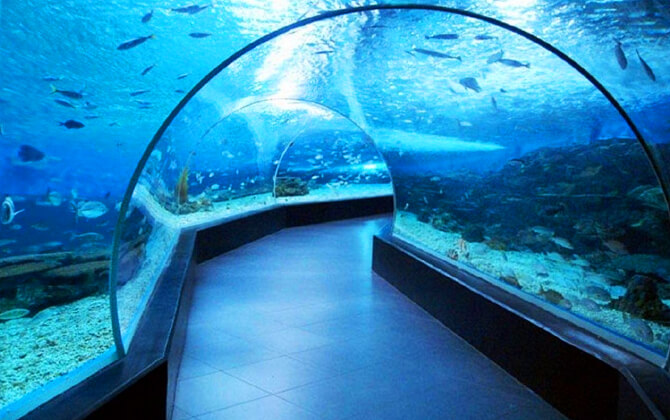
Central Terminal is useful for Intramuros, the University Belt, SM Manila, and the Pasig River ferry connection. United Nations works well for Rizal Park, the National Museum Complex, Manila Ocean Park, the National Library, and nearby government offices. Carriedo is convenient for Quiapo Church, Plaza Miranda, Binondo, and Escolta. Baclaran serves Baclaran Church, local markets, and nearby shopping centers. EDSA is a practical stop for the MRT-3 transfer, EDSA Carousel, and access toward SM Mall of Asia and other Pasay attractions.
Along the route, riders can also reach places such as Muñoz Market, Quezon City General Hospital, Ayala Malls Cloverleaf, Dangwa Flower Market, San Lazaro Hospital, Chinese General Hospital, SM San Lazaro, the Cultural Center of the Philippines, Star City, World Trade Center, the GSIS Complex, Solaire Resort, Okada Manila, Ayala Malls Manila Bay, and the airport area.
For a quick city trip, Line 1 is one of the most practical ways to move between key sights and busy urban districts.
Travel Tips
Use a Beep card if you plan to ride more than once. It speeds up entry and helps you avoid long lines for single journey tickets.
Check the direction before boarding. LRT-1 runs from Fernando Poe Jr. to Baclaran, and missing your stop can add time to the trip.
Off-peak travel is usually easier, especially if you have luggage or children with you. Rush-hour trains can get very crowded.
Expect security checks at stations and keep your belongings close. On platforms, follow the markings, let passengers exit first, and respect priority seating.
Food and drinks are not allowed inside trains or on platforms. If you are unsure about a route, ask station staff or a guard.
Keep the operating hours in mind when planning your day. LRT-1 generally runs from 4:30 a.m. to 10:00 p.m., though the timetable can change during holidays or major city events.